
Türk, Umut
Loading...
Profile URL
Name Variants
Tuerk, Umut Turk, Umut Türk, Umut
Job Title
Doç. Dr.
Email Address
umut.turk@agu.edu.tr
Main Affiliation
03.02. Ekonomi
Status
Current Staff
Website
ORCID ID
Scopus Author ID
Turkish CoHE Profile ID
Google Scholar ID
WoS Researcher ID
Sustainable Development Goals


No records found in other affiliations.
| Journal | Count |
|---|
Current Page: 1 / NaN
Scopus Quartile Distribution
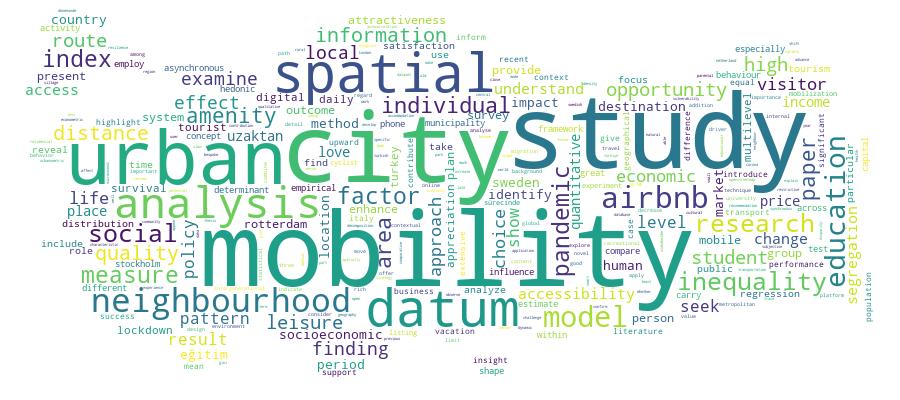
Competency Cloud
47 results
Scholarly Output Search Results
Now showing 1 - 10 of 47
Editorial Modelling Place Attractiveness in the Era of Big and Open Data Introduction(Wiley, 2022-08) Osth, John; Turk, Umut; Huang, JieArticle Spatial Proximity and Accessibility Patterns of X-Minute Cities(Elsevier Ltd, 2026) Östh, John; Türk, Umut; Kourtit, Karima; Nijkamp, PeterThe 15-minute city concept has gained prominence in urban planning as a framework linking proximity, mobility, and quality of life at the intra-urban scale. An open question is whether this concept remains meaningful when applied to spatially connected urban regions or national urban systems. To address this issue, the new X-minute city concept allows proximity thresholds to vary with spatial context, mobility conditions, and service distribution. This paper develops an operational framework with the aim to examine and highlight spatial accessibility patterns from an X-minute city perspective, using the relatively urbanized area of the Netherlands as a national-scale case study. Accessibility is analyzed at the building level using OpenStreetMap data and a combination of object-based k-nearest-neighbor measures, distance-decay functions, inequality metrics, Average Nearest Neighbor analysis, and quantile regression. Concepts from central place theory are employed as an interpretive lens to understand service clustering and accessibility patterns, rather than as a formal model to be tested. The results show pronounced spatial disparities in accessibility between urban and rural areas, as well as substantial variation within cities. Major urban centers such as Amsterdam, Rotterdam, and Utrecht exhibit high accessibility levels due to dense service provision, while peripheral and rural areas face systematically lower accessibility. Next accessibility outcomes also differ sharply across population groups. Elderly residents and groups reliant on walking experience the highest levels of inequality, with accessibility distributions remaining highly uneven at short-distance thresholds. Cycling expands the range of effective activity spaces and reduces inequality, but does not offset structural disadvantages in areas with sparse service provision. The findings point to the limits of uniform proximity targets and reveal the need for context-sensitive accessibility planning that explicitly accounts for service distribution, mobility constraints, and population heterogeneity within national urban systems.Article Citation - WoS: 15Citation - Scopus: 17Inequality in Leisure Mobility: An Analysis of Activity Space Segregation Spectra in the Stockholm Conurbation(Elsevier Sci Ltd, 2023-07) Toger, Marina; Turk, Umut; Osth, John; Kourtit, Karima; Nijkamp, PeterLeisure mobility forms an important part of people's spatial activity and mobility spectrum. This study aims to analyse the inequality dimensions of spatial mobility of individuals who seek to move to recreational and leisure destinations (often 'green' and 'blue') on designated days. The study traces - through the use of spatially dependent multilevel models - the mobility patterns of people from the greater Stockholm area, using individual pseudonymised mobile phone data and other publicly accessible data. We find significant socio-demographic inequalities in the observed residents' spatial leisure choices, where less affluent groups display especially low variation in mobility when comparing between weekdays, weekends, vacation season and work-periods.Article Citation - WoS: 3Citation - Scopus: 3Intergenerational Income Mobility in Sweden: A Look at the Spatial Disparities Across Municipalities(Wiley, 2022-08) Michelangeli, Alessandra; Osth, John; Turk, UmutThis paper provides a comprehensive overview of intergenerational income mobility in Sweden. Intergenerational income mobility is considered in both relative and absolute terms, and the analysis is carried out at the individual and municipality level. We use multilevel models to explore the correlation between upward mobility and social, economic and demographic characteristics of cities. We account for a wider set of local characteristics, such as the spatial distribution of income inequality within city and housing affordability that have not been considered by previous studies analysing social mobility in the United States or other European countries. The analyses are carried out on three subpopulations: off-spring who live in a different municipality than their parents (spatial mobile population); offspring who live in the municipality where they grew up (spatial immobile population); off-spring belonging to visible minority groups. Our results show substantial differences across municipalities, meaning that the particular combination of municipality attributes contributes to shaping the chance of status attainment among young generations. Highly mobile municipalities have more significant human capital, more residential segregation by income, more local levels of income inequality, and greater accessibility to jobs. The results indicate that dependence on parents' support and network for upward mobility is of less importance, and that spatial mobility (regardless of background) especially to larger urban areas is associated with upward mobility for the children.Article Gelir Dağılımında Fırsat Eşitsizliği ve Alt Kırılımları: Türkiye Üzerine Bir Araştırma(2020) Türk, UmutBu makale 2005 ve 2017 yılları arasındaki 12 yıl içinde Türkiye’de gelir dağılımdaki fırsat eşitsizliğini incelemeyi amaçlamaktadır. Normatif bir eşitlik kuramı olarak fırsat eşitsizliği, bireylerin çaba ve seçimleri ile bertaraf edemeyecekleri, iradeleri dışında maruz kaldıkları fayda kaybının bir ölçüsüdür. Son yıllarda fırsat eşitsizliği üzerine farklı ülkeleri ve ülkeler arası karşılaştırmalı analizleri içeren çok sayıda ampirik çalışma yapılmıştır. Özellikle mevcut veri setlerinin aile yapısıyla ilgili temel bilgileri içermemesi, bu alanda yapılan çalışmaların Türkiye özelinde sınırlı kalmasına sebep olmuştur. Bu makalede TUİK tarafından her yıl düzenli olarak derlenen Hane Halkı Gelir ve Yaşam Koşulları verilerini kullanılmıştır. Veri setinde aile yapısına dair eksik gözlemler istatistiksel metotlarla tamamlanarak, fırsat eşitsizliği analizlerinin yapılmasının mümkün olmuştur. Çalışmada gelir dağılımındaki farklılıklar cinsiyet, anne ve baba eğitim seviyesi ve ikamet edilen bölge üzerinden incelenmiş, bu faktörlerin yarattığı eşitsizlikler ayrıntılarıyla ortaya konulmuştur. Analizler 25-35 yaş aralığındaki genç nüfus için ayrıca tekrarlanarak işgücü piyasasına henüz dahil olan bireylerin karşılaştıkları fırsat eşitsizliği ve bunun alt bileşenleri incelenmiştir. Çalışmanın referans yılları küresel ekonomik kriz dönemlerini de içerdiğinden, literatürde göz ardı edilen fırsat eşitsizliği ve kriz arasındaki ilişki ile bunun genel nüfus ve genç nüfus açısında sonuçları da tartışılmıştır.Article Citation - WoS: 8Citation - Scopus: 8The Effect of Lockdown on Students' Performance: A Comparative Study Between Italy, Sweden and Turkey(Cell Press, 2023-06) Casalone, Giorgia; Michelangeli, Alessandra; Osth, John; Turk, UmutDuring the first months of the COVID-19 outbreak, countries adopted different strategies in order to mitigate the effects of the pandemic, ranging from recommendations to limit individual movement to severe lockdown measures. Regarding higher education, university studies were shifted to digital solutions in most countries. The sudden move to online teaching affected stu-dents differently, depending on the overall mitigation strategies applied. Severe lockdown and closure measures caused a disruption of their academic and social interactions. In contrast, rec-ommendations to limit activities probably did not change students' life to a great extent. The heterogeneity of the policies adopted in three countries (Italy, Sweden and Turkey) gives us an opportunity to assess the effects of lockdown measures due to the COVID-19 pandemic on uni-versity students' performance. We employ a difference-in-differences approach by exploiting the fact that Italy and Turkey experienced national lockdowns, while Sweden never applied nation-wide mandatory restrictive policies. We use administrative data from universities in the three countries to estimate the probability to pass exams after the spread of COVID-19 pandemic (and the shift to distance education), with respect to the previous comparable period. We find that the pass rate decreased with the shift to online teaching. However, lockdown measures, especially if very restrictive as those applied in Italy, helped to compensate such negative effect. A possible explanation is that students took advantage of the huge increase in the time available for their studies, given the impossibility to carry out any activity outside the home.Article Citation - WoS: 5Citation - Scopus: 7Hedonic Price Models, Social Media Data and AI - An Application to the AirBNB Sector in US Cities(Elsevier Sci Ltd, 2025-09) Osth, John; Turk, Umut; Kourtit, Karima; Nijkamp, PeterThe Airbnb sector has experienced exponential growth over the past decade and has led to extensive research in fields such as hospitality sciences, urban geography, tourism economics, and information management. This paper contributes to quantitative research in the Airbnb sector by focusing on the integration of digital platform data at the neighborhood level. It explores innovative methodologies for analyzing urban attractiveness by combining insights from hedonic pricing models with large-scale digital data sourced through AI-based approaches. This novel framework compares user-based valuations of accommodations derived from hedonic pricing with subjective, AI-generated neighborhood descriptions, offering new perspectives on data quality and reliability in information systems. The study also critically examines the challenges of integrating AI-generated content in information science, referencing also 'Garbage-in Garbage-out' and 'Bullshit-in Bullshit-out' concepts. Employing a multi-scalar modeling approach, the research examines Airbnb pricing dynamics across several U.S. cities, starting with Manhattan (USA) as an illustrative case. A subsequent large-scale application to additional metropolitan areas utilizes a combination of hedonic price modeling, social media data, and AI-generated urban descriptions, including a Shapley decomposition analysis. This interdisciplinary integration provides actionable insights into neighborhood attractiveness and pricing mechanisms, while highlighting methodological and empirical contributions to the broader field of information management. By employing the relationship between AI-driven textual data and quantitative modeling, this research provides added value in analyzing urban information systems and their application to digital platforms.Article Citation - WoS: 14Citation - Scopus: 17How Much Does Geography Contribute? Measuring Inequality of Opportunities Using a Bespoke Neighbourhood Approach(Springer Heidelberg, 2019-03-30) Turk, Umut; Osth, JohnTo what extent an individual is successful in a variety of outcomes is the result of multiple factors such as (but not limited to) parental background, level of education, discrimination and business cycles. Factors like these also indicate that the success in life can be attributable to factors that both take individual-level merits into account but also to structural factors such as discrimination and contextual effects. Over the last decades, a growing interest in decomposing and categorising factors that affect the life chances of individuals has led to the formation of inequality of opportunity as a research field. This paper builds upon this growing literature, which amounts to quantify the contribution of factors that lie beyond the control of individuals to the total inequality observed in different spheres of life. Using rich Swedish longitudinal register data, we are able to follow individuals over time and their educational attainment during upbringing and later labour market outcomes. In difference from other inequality of opportunity studies, we make use of an egocentric neighbourhood approach to integrate the socio-economic composition of the parental neighbourhood in an inequality model and illustrate its contribution to the total inequality in both outcomes quantitatively. Using multilevel regression analyses, we show that the parental neighbourhood is highly influential in educational attainment and remains so for market outcomes even years after exposure.Article Citation - WoS: 4Citation - Scopus: 4Inequality in Access to Urban Amenities(Springernature, 2025-07-12) Michelangeli, Alessandra; Osth, John; Toger, Marina; Turk, UmutThis paper provides an overview of urban inequality in the Stockholm Metropolitan Area analyzing the spatial distribution of amenities and their accessibility. Inequality in urban amenities is measured by a multidimensional index at a fine geographical scale and it can be decomposed into the sum of inequality indices computed on the marginal distributions of amenities across locations plus a residual term accounting for their joint distribution. Our research leverages a unique dataset that combines income data for approximately 90,000 geocoded individuals residing in the metropolitan area with information from the OpenStreetMap platform, enabling us to examine the distribution of both natural and urban design-related amenities. Furthermore, we integrate data from online platforms to analyze the housing market. Our findings reveal moderate levels of inequality in amenities within the Stockholm Metropolitan Area, with social segregation emerging as the primary driver of this inequality.Article Citation - WoS: 3Citation - Scopus: 4Route Choice to Inform Navigation System Design and Accessibility Analysis for Older Pedestrians: A Scoping Review(Elsevier Sci Ltd, 2025-10) Fulman, Nir; Huber, Johannes; Lloyd, Armagan Teke; Foshag, Kathrin; Grinblat, Yulia; Turk, Umut; Zipf, AlexanderIntroduction: Routing systems can support older adults by helping them overcome barriers to walking, promoting independence and well-being. The paths generated by these systems also inform urban accessibility metrics, such as those used in 15-min-city planning. Yet current systems rarely reflect the preferences or constraints of older pedestrians. Empirical studies of route choice can help close this gap by revealing how people trade off different route attributes in real settings. Methods: We conducted a scoping review, following PRISMA-ScR guidelines, of empirical studies analyzing pedestrian route choice among adults. The goal was to identify findings that could inform the design of more age-inclusive routing tools. Results: Eleven studies met the inclusion criteria, eight of which focused exclusively on older adults. Despite varied contexts, three consistent themes emerged: (i) sidewalk quality and manageable gradients; (ii) aesthetic and sensory comfort, including greenery, low noise, and good lighting; and (iii) access to benches, transit, and everyday amenities. However, most studies relied on qualitative methods, limiting direct integration into routing algorithms. Conclusions: Future work should prioritize hybrid qualitative-quantitative designs, large-scale sampling of routes, and fine-grained mapping of micro-barriers. Analyses should account for age, gender, and functional ability, and consider circular leisure walks as a distinct travel pattern. These directions can enhance the usability and equity of routing systems and urban planning frameworks.