
Dinçer, Evren Mehmet
Loading...
Profile URL
Name Variants
Dincer, Evren M. Dinçer, Evren M. Dinçer, Evren Mehmet Evren Mehmet Dinçer
Job Title
Dr. Öğr. Üyesi
Email Address
evren.dincer@agu.edu.tr
Main Affiliation
06.03. Sosyoloji
Status
Current Staff
Website
ORCID ID
Scopus Author ID
Turkish CoHE Profile ID
Google Scholar ID
WoS Researcher ID
Sustainable Development Goals


No records found in other affiliations.
| Journal | Count |
|---|
Current Page: 1 / NaN
Scopus Quartile Distribution
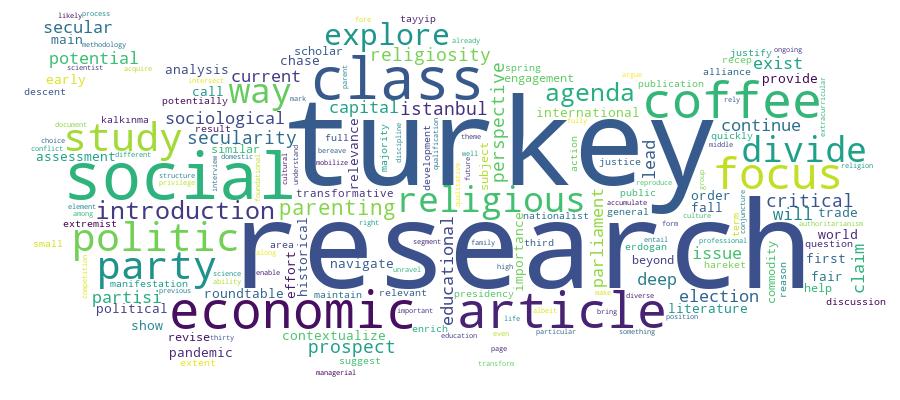
Competency Cloud
7 results
Scholarly Output Search Results
Now showing 1 - 7 of 7
Editorial Editors' Introduction: Fall 2025(Cambridge Univ Press, 2025-10-28) Dincer, Evren M.; Yukseker, Deniz; Kolluoglu, BirayArticle Citation - WoS: 1Citation - Scopus: 1Chasing Coffee: A New Research Agenda in Turkey(Springer, 2020-06) Dincer, Evren M.; Ozcelik, AyseThis article is a call for a new research agenda: a socio-economic analysis of coffee in Turkey. To contextualize the importance and relevance of this effort, it first provides a critical assessment of the literature on coffee in Turkey by focusing on its two main manifestations: historical and sociological constellations. We show how earlier critical engagement with coffee as a commodity and a research subject helped scholars revise and go beyond the existing scholarship. We then claim a similar transformative prospect exists for political-economic manifestations of coffee today. We justify our claim by suggesting six potential research areas with relevant research questions and potentially enriching outcomes.Article Citation - WoS: 7Citation - Scopus: 8Parenting and Education: Navigating Class, Religiosity and Secularity in Istanbul(Routledge Journals, Taylor & Francis Ltd, 2023) Kolluoglu, Biray; Dincer, Evren M.This article studies the educational choices that secular and religious professional and managerial middle-class parents in Istanbul make for their children. It explores the ways in which class intersects with religion in Turkey where, politics, culture, social, and even economic life are marked by a deep divide among the religious and the secular. Focusing on a particular segment of the middle classes, that with higher economic and social capital, the article brings to fore the ways in which religiosity and secularity structure the processes of transforming privileges into acquired rights in the form of educational qualifications and extracurricular skills. It explores the current sociological conjuncture that bereaves both groups, albeit in different ways, of their ability to fully mobilize their accumulated economic, social, and cultural capitals in reproducing their class position in their children. The article argues that exploring the parenting of education along the secular and the religious divide can unravel the foundational elements of the ongoing competition and conflict in Turkey and enables a deeper understanding of the current divide and the potential for a future reconciliation. The study relies on a qualitative study that entails interviews with thirty families and two focus groups.Article Citation - WoS: 5Citation - Scopus: 7New Perspectives on Turkey Roundtable on the COVID-19 Pandemic : Prospects for the International Political Economic Order in the Post-Pandemic World(Cambridge Univ Press, 2020-09-21) Bugra, Ayse; Gurkaynak, Refet; Keyder, Caglar; Palat, Ravi Arvind; Pamuk, Sevket; Dincer, Evren M.Editorial Editors' Introduction(Cambridge University Press, 2023-10-12) Yükseker, Deniz; Kolluoǧlu, Biray; Dinçer, Evren M.Editorial Editors’ Introduction: Spring 2026(Cambridge Univ Press, 2026) Kolluoğlu, Biray; Dinçer, Evren M.; Yükseker, DenizEditorial Editors' Introduction(Cambridge University Press) Yükseker, Deniz; Kolluoǧlu, Biray; Dinçer, Evren MehmetSince before the publication of New Perspectives on Turkey’s spring 2023 issue, politics has been at the top of the agenda of public discussions in Turkey. The reason was the general elections for the presidency and the parliament on May 14; in the run-off on May 28, Recep Tayyip Erdogan was re-elected for a third, five-year term and the party ˘ he leads, the Justice and Development Party (Adalet ve Kalkınma Partisi; AKP), maintained its majority in the parliament in an alliance with the Nationalist Action Party (Milliyetçi Hareket Partisi; MHP) and smaller extremist parties. To what extent and how quickly the election results will lead to a further descent into full authoritarianism – already well documented in the pages of previous NPT issues – is something that social scientists are likely to continue to observe. Domestic politics therefore will continue to be an important theme for social science research on Turkey from diverse disciplines and methodologies