Şık, Kübra

Loading...
Name Variants
K. Sık Sik Keser, Kübra Şik Keser, Kübra
Job Title
Öğr. Gör.
Email Address
kubra.keser@agu.edu.tr
Main Affiliation
09. Yabancı Diller Yüksekokulu
Status
Current Staff
Website
Scopus Author ID
Turkish CoHE Profile ID
Google Scholar ID
WoS Researcher ID

Sustainable Development Goals

This researcher does not have a WoS ID.
No records found in other affiliations.
JournalCount
Current Page: 1 / NaN

Scopus Quartile Distribution

Competency Cloud

GCRIS Competency Cloud

Scholarly Output Search Results

Now showing 1 - 2 of 2
  • Book Part
    Citation - Scopus: 2
    Upholding Academic Integrity in EAP
    (Springer Nature, 2024) Şik Keser, Kübra; Razı, Salim
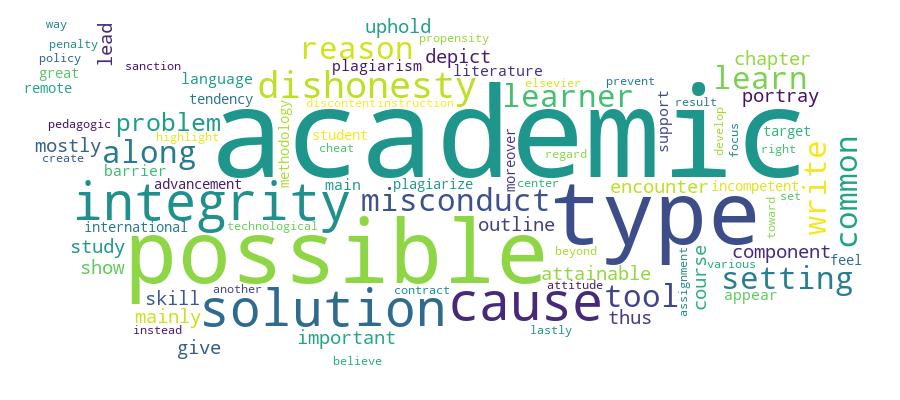
    Given that academic integrity is an important component in academic writing courses, outlining the types of academic misconduct that are mostly encountered in EAP settings along with the possible causes can lead to possible solutions and suggestions. Thus, in this chapter, we depict the types of academic dishonesty in EAP settings based mainly on writing skills and portray the possible causes along with the attainable suggestions. Studies on academic integrity show that plagiarism is the most common type of academic misconduct. Language barrier appears to be the main reason, and literature supports that international students have a greater tendency to plagiarize due to feeling incompetent in the target language. Moreover, with advancements in remote learning methodologies and technological tools, learners have a propensity to use AI tools while creating their assignments, believed to be a problem beyond plagiarism. Lastly, contract cheating is another common type of academic dishonesty in EAP settings. The reasons are highlighted as discontent about the setting of the instruction and learning and the attitude of learners toward various ways of cheating. For all these problems and causes, a penalty would be regarded as a possible solution or suggestion. However, instead of focusing on the results of academic dishonesty and sanctions, solutions should be centered on the pedagogic policies developed to prevent academic misconduct. © 2025 Elsevier B.V., All rights reserved.
  • Article
    Effects of Mobile Assisted Language Learning on Listening Strategy Preference of Foreign Language Students
    (2025-11-29) Keser, Kübra
    The study examines the listening strategy preferences of advanced EFL students, considering the influence of mobile-assisted language learning (MALL). With technological advancements shaping language learning, this research explores two key questions: the impact of MALL on students’ listening strategy use and their perceptions of mobile apps for listening practice. Participants include advanced-level preparatory students at a public university in Türkiye, who have previously undergone a listening strategy training programme (LSTP) developed by Keser (2021). The study follows a mixed-method research design based on grounded theory for the qualitative part, employing an experimental approach for the quantitative part. Two groups, each with 21 students, were observed over seven weeks; the first week was separated for a pre-test. The experimental group used various mobile apps outside the classroom to enhance listening skills, while the control group relied solely on course materials. Qualitative data collection involved observation notes and semi-structured interviews, analyzed through open, axial, and selective coding. Pre- and post-test results were analyzed through paired-samples t-test and independent samples t-test. The findings categorize the listening strategies employed as cognitive or metacognitive and highlight their usage in relation to mobile apps. The results provide valuable insights for both lecturers and students, offering guidance on selecting appropriate listening strategies and mobile apps to improve listening skills.