
Sütçü, Muhammed
Loading...
Profile URL
Name Variants
Sütçü, Muhammed Sutcu, Muhammed
Job Title
Email Address
Main Affiliation
01. Abdullah Gül University
Mühendislik Fakültesi
Endüstri Mühendisliği
Mühendislik Fakültesi
Endüstri Mühendisliği
Status
Former Staff
Website
ORCID ID
Scopus Author ID
Turkish CoHE Profile ID
Google Scholar ID
WoS Researcher ID
Sustainable Development Goals

This researcher does not have a Scopus ID.

This researcher does not have a WoS ID.
No records found in other affiliations.
| Journal | Count |
|---|
Current Page: 1 / NaN
Scopus Quartile Distribution
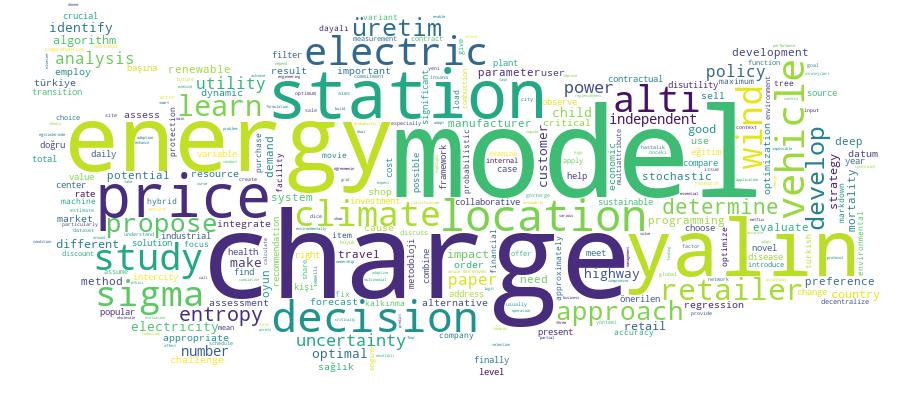
Competency Cloud
20 results
Scholarly Output Search Results
Now showing 1 - 10 of 20
Master Thesis Sağlık için Kalkınma Yardımında Öncelikli Bölgeler: Kanıta Dayalı Bir Yaklaşım(Abdullah Gül Üniversitesi, Fen Bilimleri Enstitüsü, 2021) Chbani, Zakaria; Sütçü, MuhammedSon yıllarda sağlık alanında kalkınma yardımlarının uygunluğu ve hangi kriterlere göre belirleneceği büyük ilgi görmektedir. Bu alanda yapılan çalışmalarda, kişi başına Gayri Safi Milli Hasıla (GSMH)'nın tek indikatör olarak kullanılmasından dolayı kritik sorunlar ortaya çıkmıştır. Bu konudaki en kritik eleştiri, kişi başına düşen GSMH'nin orta gelirli ülkelerin analizlerinde çok büyük sapmalara sebep olmasıdır. Bu ülkeler önemli dezavantajlara sahip olmakla birlikte en yüksek yoksulluk ve hastalık yüküne sahip ülkelerdir. Kişi başına GSMH'nın hesaba katmadığı bazı alternatif çalışmalar literatürde önerilmiştir. Bu tez, önceki çalışmaları temel alarak, kalkınma yardımlarının uygunluğu ve tahsis kararlarında kullanılan verilere dayalı bir metodoloji sunmaktadır. Bu metodoloji, sağlık durumu ölçütlerini (bir nüfusun sağlık ve hastalık düzeyini tahmin eden) ve hastalık yüküne tepki kapasitesi ölçütlerini birleştirir. Bu çalışmada Yeti Yitimine Ayarlanmış̧ Yaşam Yılı sağlık durumunun bir ölçüsü olarak kullanılmaktadır. Kapasite ölçülerini belirlemek için öncelikli olarak literatürde kullanılan ilgili göstergeleri kapsayan bir gösterge kümesi oluşturulmuştur. Bu gösterge kümesini kullanarak, öznitelik seçimi metodu ile daha küçük ve tanımlayıcı gösterge alt kümesi oluşturulmuştur. Son olarak, seçilen göstergelerin modelde kullanılması ile ülkeler için öncelik sıralamayı elde edilmiştir. Önerilen metodoloji, kişi başına GSMH ve önceki çalışmalarla karşılaştırılarak, önerilen metodolojinin üstünlükleri gösterilmiştir. Önerilen yeni hesaplama metodolojisi 'hastalık yükü yüksek ülkeleri' ve 'aşırı yoksulluk içindeki nüfusu' hedefleyen diğer birçok metodolojiden daha iyidir. Ayrıca, önerilen metodoloji önceki çalışmalarda ele alınmayan yada çözülemeyen bazı endişeleri de kapsamaktadır.Article Citation - WoS: 4Citation - Scopus: 10Probabilistic Assessment of Wind Power Plant Energy Potential Through a Copula-Deep Learning Approach in Decision Trees(Cell Press, 2024-04) Sahin, Kubra Nur; Sutcu, MuhammedIn the face of environmental degradation and diminished energy resources, there is an urgent need for clean, affordable, and sustainable energy solutions, which highlights the importance of wind energy. In the global transition to renewable energy sources, wind power has emerged as a key player that is in line with the Paris Agreement, the Net Zero Target by 2050, and the UN 2030 Goals, especially SDG-7. It is critical to consider the variable and intermittent nature of wind to efficiently harness wind energy and evaluate its potential. Nonetheless, since wind energy is inherently variable and intermittent, a comprehensive assessment of a prospective site's wind power generation potential is required. This analysis is crucial for stakeholders and policymakers to make well-informed decisions because it helps them assess financial risks and choose the best locations for wind power plant installations. In this study, we introduce a framework based on Copula-Deep Learning within the context of decision trees. The main objective is to enhance the assessment of the wind power potential of a site by exploiting the intricate and non-linear dependencies among meteorological variables through the fusion of copulas and deep learning techniques. An empirical study was carried out using wind power plant data from Turkey. This dataset includes hourly power output measurements as well as comprehensive meteorological data for 2021. The results show that acknowledging and addressing the non-independence of variables through innovative frameworks like the Copula-LSTM based decision tree approach can significantly improve the accuracy and reliability of wind power plant potential assessment and analysis in other real-world data scenarios. The implications of this research extend beyond wind energy to inform decision-making processes critical for a sustainable energy future.Article Analysis of Under-Five Mortality by Diseases in Countries With Different Levels of Development: a Comparative Analysis(2023-07-03) Ersöz, Nur Şebnem; Sütçü, Muhammed; Şahan, Pınar GünerObjectives: The right to health is critical for children because they are sensitive beings who are more susceptible to disease and health problems. It would be beneficial to compare child mortality rates in countries with different levels of development and to conduct studies to address them by taking into account their causes. This study aims to analyze the situation of developed, developing and least developed countries in terms of causes under-5 child mortality (U5CM) determined by World Health Organization and to identify the similarities or differences of under-five mortality. Methods: Child mortality rates per 1,000 live births between 2000 and 2017 years in between different age groups (0-27 days and 1-59 months) by causes (disease-specific) were obtained from World Health Organization for a total 15 countries including developed, developing and least developed countries. Regression analysis was performed to identify which causes have more impact on child mortality. In addition, the relationship between diseases was calculated using Euclidean distance, and diseases were clustered using k-means clustering algorithm for each country. Results: As a result of mathematical and statistical analysis, it was seen that causes of child mortality have a significant relation with the development level of country where a child was born. Conclusions: It has been observed that the causes of child mortality in countries with different levels of development vary depending on different factors such as geographical conditions, air quality population and access to medicine.Article Citation - WoS: 4Citation - Scopus: 4Parameter Uncertainties in Evaluating Climate Policies with Dynamic Integrated Climate-Economy Model(Springer Nature, 2023-05-04) Sutcu, MuhammedClimate change is a complex issue with significant scientific and socio-economic uncertainties, making it difficult to assess the effectiveness of climate policies. Dynamic Integrated Climate-Economy Models (DICE models) have been widely used to evaluate the impact of different climate policies. However, since climate change, long-term economic development, and their interactions are highly uncertain, an accurate assessment of investments in climate change mitigation requires appropriate consideration of climatic and economic uncertainties. Moreover, the results of these models are highly dependent on input parameters and assumptions, which can have significant uncertainties. To accurately assess the impact of climate policies, it is crucial to incorporate uncertainties into these models. In this paper, we explore the impact of parameter uncertainties on the evaluation of climate policies using DICE models. Our goal is to understand whether uncertainty significantly affects decision-making, particularly in global warming policy decisions. By integrating climatic and economic uncertainties into the DICE model, we seek to identify the cumulative impact of uncertainty on climate change. Overall, this paper aims to contribute to a better understanding of the challenges associated with evaluating climate policies using DICE models, and to inform the development of more effective policy measures to address the urgent challenge of climate change.Article Citation - Scopus: 1Electricity Load Forecasting Using Deep Learning and Novel Hybrid Models(Sakarya University, 2022-02-28) Sutcu, Muhammed; Şahi̇n, Kübra Nur; Koloğlu, Yunus; Çelikel, Mevlüt Emirhan; Gulbahar, Ibrahim TümayLoad forecasting is an essential task which is executed by electricity retail companies. By predicting the demand accurately, companies can prevent waste of resources and blackouts. Load forecasting directly affect the financial of the company and the stability of the Turkish Electricity Market. This study is conducted with an electricity retail company, and main focus of the study is to build accurate models for load. Datasets with novel features are preprocessed, then deep learning models are built in order to achieve high accuracy for these problems. Furthermore, a novel method for solving regression problems with classification approach (discretization) is developed for this study. In order to obtain more robust model, an ensemble model is developed and the success of individual models are evaluated in comparison to each other. © 2025 Elsevier B.V., All rights reserved.Article Machine Learning and Scenario-Based Forecasting of Türkiye’s Renewable Energy Transition toward Net-Zero 2053(Elsevier Ltd, 2026-05) Sutcu, Muhammed; Yildiz, Baris; Sahin, Nurettin; Almomany, Abedalmuhdi; Gulbahar, Ibrahim TumayThe issue of global warming has been identified as one of the most critical challenges of the 21st century, with the consumption of fossil fuels being identified as a major contributor to greenhouse gas emissions. In response to these challenges, countries worldwide are expediting their transition towards renewable energy sources to meet international climate commitments, such as the Paris Agreement, and to achieve long-term sustainability goals. Türkiye has established a target to achieve net-zero emissions by 2053. This objective is consistent with both the nation's domestic energy strategy and its international commitments. Nevertheless, the transition from fossil fuels to renewable energy sources is impeded by geographical, economic, and technological constraints. The present study aims to assess the capacity and efficiency of renewable energy in Türkiye with environmental protocols and future electricity demand projections. Electricity generation, transmission data, and national energy plans are used to identify future electricity generation and capacity trends. In the context of this study, a range of machine learning models is executed across diverse scenarios, yielding a series of outcomes. Consequently, the repercussions of regulatory measures and financial investments were examined, and prospective inferences were derived. The findings underscore the pivotal role of scenario-based modeling in formulating sustainable energy policies and directing investment decisions within the context of climate change mitigation.Article Citation - WoS: 4Citation - Scopus: 6A Variant SDDP Approach for Periodic-Review Approximately Optimal Pricing of a Slow-Moving a Item in a Duopoly Under Price Protection With End-Of Return and Retail Fixed Markdown Policy(Pergamon-Elsevier Science Ltd, 2023-02) Yildiz, Baris; Sutcu, MuhammedIn this paper, we examine a selling environment where a manufacturer-controlled retailer and an independent retailer sell a slow-moving A item. The manufacturer offers the independent retailer a price protection contract stipulating that the manufacturer reimburses the independent retailer in case of a reduction in the wholesale price. The price set by the independent retailer is assumed to be determined by Retail Fixed Markdown (RFM) policy. The manufacturer also offers the independent retailer a special discount rate for the replenishment orders and the retailers are assumed to follow (R, S) inventory replenishment policy. The manufacturer adopts a periodic-review pricing strategy and the mean demand observed by each retailer in a given period depends on the prices. We also take the customers choosing no-purchase option into account. We employ multinomial logit (MNL) models to forecast customers' preferences based on retail prices. The retailers' market shares are esti-mated by customized choice probability functions. We propose stochastic programming models to determine the manufacturer's pricing strategy. Then, we propose a variant Stochastic Dual Dynamic Programming (SDDP) algorithm to determine the manufacturer's approximately optimal pricing strategy by getting around three curses of dimensionality. Then, we move on to the observations on the impact of four critically important contractual parameters on the price, the market shares and the expected total net profits and finally discuss some possible approaches for the selection of the best compromise values of those contractual parameters.Article Citation - WoS: 14Citation - Scopus: 17Optimizing Electric Vehicle Charging Station Location on Highways: A Decision Model for Meeting Intercity Travel Demand(MDPI, 2023-12-11) Gulbahar, Ibrahim Tumay; Sutcu, Muhammed; Almomany, Abedalmuhdi; Ibrahim, Babul Salam K. S. M. KaderElectric vehicles have emerged as one of the top environmentally friendly alternatives to traditional internal combustion engine vehicles. The development of a comprehensive charging infrastructure, particularly determining the optimal locations for charging stations, is essential for the widespread adoption of electric vehicles. Most research on this subject focuses on popular areas such as city centers, shopping centers, and airports. With numerous charging stations available, these locations typically satisfy daily charging needs in routine life. However, the availability of charging stations for intercity travel, particularly on highways, remains insufficient. In this study, a decision model has been proposed to determine the optimal placement of electric vehicle charging stations along highways. To ensure a practical approach to the location of charging stations, the projected number of electric vehicles in Turkiye over the next few years is estimated by using a novel approach and the outcomes are used as crucial input in the facility location model. An optimization technique is employed to identify the ideal locations for charging stations on national highways to meet customer demand. The proposed model selects the most appropriate locations for charging stations and the required number of chargers to be installed, ensuring that electric vehicle drivers on highways do not encounter charging problems.Article Optimal Location Determination of Electric Vehicle Charging Stations: A Case Study on Turkey's Most Preferred Highway(2022-06-30) Gülbahar, İbrahim Tümay; Sütçü, MuhammedToday, electric vehicles are seen as one of the most suitable and environmentally friendly alternatives to internal combustion engine vehicles. An important issue related to the dissemination of electric vehicles is the location of the vehicle charging network and specifically the optimum location selection of the charging stations. Generally, most of the studies focus on popular destinations such as city centers, shopping areas, bus stations, and airports. Although these places are often used in normal life, they can usually provide an adequate solution for daily charging needs due to the number of alternative charging stations. However, finding adequate charging stations is not possible in intercity travels especially in highways. In this paper, we proposed a decision model to determine the location of electric car charging stations in highways. We create an optimization model to decide the optimum locations for the charging stations that can meet the customer demands on the Istanbul-Ankara highway. The proposed model determines optimum charging stations that enable passengers traveling with their electric vehicles to travel in Istanbul-Ankara highway in the shortest time.Master Thesis Türkiye'de Elektrikli Araç Sarj İstasyonu Lokasyonu Belirleme(Abdullah Gül Üniversitesi, Fen Bilimleri Enstitüsü, 2023) Gülbahar, İbrahim Tümay; Sütçü, MuhammedElectric vehicles are now regarded as one of the best and greenest replacements for internal combustion engine vehicles. For the widespread use of electric vehicles, the construction of the vehicle charging network and, in particular, the choice of the appropriate site for the charging stations, are viewed as critical issues. The majority of studies on the topic concentrate on well-known locations like city centers, shopping malls, and airports. Because there are so many alternative charging stations, even though these and comparable locations are regularly used in everyday life, they can usually provide an appropriate solution to the daily charging need. For intercity travel, it is impossible to find enough charging stations, especially on highways. To choose the position of electric vehicle charging stations on highways, a decision model has been suggested in this study. The anticipated number of electric vehicles in Türkiye over the next few years is projected in order to acquire a realistic approach to the location of charging stations, and this amount is employed as a significant input in the facility positioning model. The best places for charging stations on state highways that can meet customer demand were then identified using an optimization technique. The suggested model selects the most suitable locations for charging stations and the number of chargers that should be installed there while also making sure that drivers of electric vehicles on highways don't run into charging issues.